|
Pile Driving Analyzer (PDA)
Depending on the requirements of
the project, dynamic pile testing in today’s
high foundation loads require modern
construction control. The Pile Driving Analyzer
(PDA) helps to quickly evaluate the integrity
and bearing capacity of the entire pile
installation. It improves quality control,
quality assurance for driven
piles.
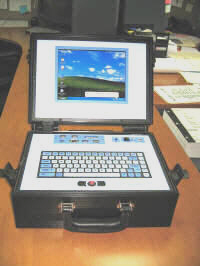
HRES has monitored several piles
dynamically, using a PAK pile driving analyzer
to evaluate the actual hammer/piling system
performance, pile driving stresses, energy
transfer to the pile, pile structural integrity,
pile capacity, and soil behavior. Dynamic
measurements of strain and acceleration will be
taken near the top of each pile using strain
transducers and piezoelectric accelerometers
that bolt to the pile and connect to the PDA.
HRES is well-experienced and thoroughly familiar
with field connections and monitoring of both
pre-stressed concrete and steel pipe piles.
The PDA converts pile strains to
forces and accelerations to velocities as a
function of time for each hammer blow. Using
wave propagation theory, dynamic variables, such
as maximum pile driving forces, maximum pile top
hammer transferred energy, and ultimate pile
static capacity, are computed and available for
display and printing for each hammer blow during
driving. Excessive driving stresses are a
frequent cause of pile failure and would
typically be corrected by various methods
including temporarily reducing hammer energy,
increasing pile cushion thickness etc.
If pile damage is suspected
during the handling or installation of any test
or production piles, HRES can perform low-strain
integrity testing using a Pile Integrity Test
(PIT) Collector System to further assess the
potential damage.
CAPWAP Analyses
The Case Wave Analysis Program
version (CAPWAP) is an analytical procedure
performed using a micro-computer that was
developed by GRL & Associates to compute soil
resistance forces and their distributions using
pile top force and velocity measurements
recorded in the field (Rausche, 1970).
CAPWAP analyses will be performed
by HRES using PDA data from selected hammer
blows. Results of these analyses will be used
to estimate ultimate static pile capacity, along
with soil quake and damping parameters and soil
resistance distributions to be used in
subsequent final driving wave equation
analyses. If PDA data indicates that time
dependent soil strength changes are affecting
pile capacity, a re-strike blow will also be
chosen for CAPWAP analyses. It is important to
choose a blow from early in the re-strike that
exhibits a high-energy blow so as to yield
maximum information regarding soil resistance
and long-term pile static capacity.
The method of superposition may
be used when analyzing end of drive and
beginning of re-strike dynamic pile data
according to the CAPWAP method. In cases of
very high (more than 15 blows per inch) blow
counts, end bearing from end of drive analysis
may be added to skin friction from beginning of
re-strike analysis to obtain a total and a
long-term pile capacity. This approach, of
course, assumes that end bearing does not
significantly change with time.
Final Wave Equation Analysis and
Pile Driving Criteria
Based on the results of the
CAPWAP analysis, final wave equation analysis (WEAP)
may be performed. HRES will provide graphs
portraying ultimate pile capacity and
compressive and tensile stresses as a function
of number of hammer blows.
|